Euro, złoty, hryvnia - 1.

Spring journeys are the best: no heat, no high prices, no crowds of ill mannered, loud tourists. Blooming trees and fresh grass make any country look fine. We said we wouldn't stop till we get to Slovakia. And yes, we managed to stop only twice: once in Nagykároly (Carei in Romanian) to visit the castle of the Károlyi family, a beautifully renovated building with a spectacular interior.


We couldn't and didn't even try to resist temptation while passing the Tokaj wine region in Hungary, so we stopped again to buy some wine from a local producer. Our destination was Kosice (Kassa in Hungarian) where we arrived late and took us some time to find a parking place, so we raced to the cathedral to find it open. This beautiful Gothic style construction is interesting for Hungarians not only for its beautiful winged altar and pretty interior but for Francis II Rákóczi's tomb, prince of Transylvania and leader of an uprising against the Habsburg House which ended with his exile in Turkey. He died in Tekirdag (in Hungarian: Rodostó) and was buried in 1735 in Istanbul, in the Saint-Benoit (then Jesuit) French church in Galata, next to his mother, Ilona Zrínyi. In 1906 his remains were moved to the St. Elisabeth Cathedral in Kassa where he rests next to his mother and son. A few years later, at the end of the 1st World War Hungary lost 2/3 of its territories and Kassa became part of Slovakia, so Francis II Rákóczi rests in a foreign country again.


The caretaker of the cathedral spoke Hungarian and recommended us a cheap hostel which proved quite expensive for us. Since they switched their currency to euro their prices went up. We continued our journey to Poland the next morning and stopped in Bártfa (Bardujevo in Slovakian), a surprisingly beautiful and completely untouristic town. The church and town hall are surrounded by neat and pretty "gingerbread" houses. Bártfa is often mentioned in Kálmán Mikszáth's novels and short stories and it reminded me of my beloved childhood readings. I really liked Bártfa and I hope I can return there again.


We continued our journey to Krakow. The landscape was hilly, the peaks were spotted with picturesque fortresses.


We crossed the border soon after leaving Bártfa (Bardujevo) and arrived in Poland. The road ran through beautiful, dense pine forests with very little traffic. When we saw the first village we realised that the area was inhabited by a minority (Ukrainians perhaps?) because the churches we passed were Orthodox, not Catholic. Like this one:


In the First World War the eastern front, where Austrian-Hungarian troops were fighting Russian forces was stretching through Galicia, an area covering the southeast of Poland and the upper western part of Ukraine. My great grandfather's brother died in 1916 in Galicia, around a town situated now in Ukraine, at the age of 21, due to an abdominal shot. On her deathbed his sister (my aunt) asked us to find his grave when we would have the chance to. At that time the area was part of the USSR and such a visit was out of question. But now Ukraine is a separate state, we don't need a visa any more, so I am planning to start a search soon. I have already sent several letters to different organisations dealing with this issue and I hope that I'll be able to track the exact place.

War cemeteries are frequent in the eastern parts of Poland. Some have names, others only bear numbers (up to 134). All of them are clean, well maintained and it is easy to find them. We visited one around Gorlice. It was a silent place in the forest, the air was fresh and birds were singing. Those buried here were mostly Ukrainian and Polish but we found a few Hungarian names too.


We stopped for a quick lunch in Gorlice and continued our journey to Krakow.

Around Nemrut Dag


If you wake up at 3 a.m. and climb Nemrut dag to see the sunrise you're not done. The Nemrut National Park hides a lot more than just a few giant sculptures on a peak. But it is impossible to visit them on foot or by dolmuş (small bus connecting remote villages and towns), so you'd need a car. Our first stop was the ancient town of Arsemia, the summer capital of the Commagene Kingdom built by King Antiochus I  in honor of his father King Mithridates I Callinicus.  This tranquil archeological site lies on a hillside, is rarely visited and offers a beautiful view on the surrounding mountains and the Nymphaeus river (tributary of the Euphrates) flowing below. 


The huge carving picturing King Mithridates I shaking hands with Hercules himself is one of the reasons why Arsemia is worth visiting. It is said that it dates back to 50 A.D.


Next to it we may find the largest rock inscription in Anatolia and a strange stairway descending deep down below the surface. My son and husband tried to reach its end but they gave up because it was too dark to walk further safely. Some guidebooks say that this hole was used to store water supplies. But who would write such an amount of text on the outside walls of a reservoir?

It was only mid-day but the heat was difficult to tolerate. After leaving the Arsemia archeological site we passed Yeni Kale, an interesting fortress built on the top of a rock. It's the place where the castle of Arsemia stood once but what we see nowadays is a 13th-century Mameluk fortress. The rock seemed difficult to climb, especially in 43 degrees Celsius.


The valley broadened soon and we caught the first glimpse of the magnificent Roman bridge built over the river in the 2nd century A.D. 


Each end of this magnificent construction is guarded by a pair of Corinthian columns. They provide a nice shade for the dog and kids of the souvenir vendor. The surviving Latin stellae states that the bridge was built in the honour of the Roman emperor Septimius Severus and his family.


The burial mound on the top of the Nemrut mountain is not the only one in the region. There is a second one in Karakuş, built in 36 B.C. by the Commagene king Mithridates II for his mother, Isas. On our way we caught a glimpse of the Euphrates again.
Apart from us there were no visitors in Karakuş. The mound has two columns on the eastern, one at the western and another one at the southern side. The top of the columns carry lion and eagle statues, on one of the western columns there is a ‘shaking hands’ relief. My son enjoyed sitting in the shade of a lion statue placed on the ground while we walked around the site.


We drove back to Kahta and Adiyaman through a landscape spotted with olive groves and orchards. Then in Adiyaman we realised that my son had very high fever and a serious tonsil infection.


Türkiye 2014/4 - Nemrut dağ


A 2137 m high peak situated in the Kurdish land. If you climb to the top, you may look down on the Euphrates and the surrounding mountains. Mistery hunters like Daniken consider it a realm of the paranormal while according to the official records, in 62 BC Antiochus I, king of Kommagene built a tomb-sanctuary on the top and decorated it with huge statues depicting lions, eagles, different gods and, obviously, himself. One thing is certain: it was a heroic work to carry them up there, and owing to its limited military importance and steep slopes, the statues are still more or less in place.


Nemrut dağ is the perfect place to enjoy the sunrise or sunset. When we saw it 15 years ago the area was considered unsafe (Turkish military sometimes collided with the Kurds in that region) and most of the visitors were Turkish citizen. The road leading up to the peak was unpaved and dusty, and we had to walk the last two or three kilometres in dark. It was August but the morning was very cold, we tried to hide behind a stone lion to avoid the wind. When finally the sun rose and lit the narrow, shiny string of water stretching at the feet of the mountains, everyone around us turned towards it and started to pray. It was a magical moment, we saw a prayer to the Sun god.


15 years later there were no Turks any more, only loud tourists who climbed the statues and took pictures of each other. My son woke up obediently at 3 a.m. and climbed the peak without a word, he did not mind neither the snake he saw on the way nor the cold wind. We found a few ladybugs hiding under the stones, waiting for the warm rays of the sun and he counted them. But he was happy to return to the warm room of the small hostel where we spent the night.


- to be continued -

Türkiye 2014/3 - Göbeklitepe


The motorway to Urfa seemed almost unreal after the dusty desert road but we soon left it and headed for Göbeklitepe, a neolithic site dating from the 10th-8th millennium BC.


It was a bit late and we were afraid that it would be closed but at the entrance we discovered that their opening hours were more than lax: the site is open from sunrise to sunset, whatever that means. I'm sorry I didn't take a picture of the sign. The site is in a strategic place, well above the surrounding hills and according to Klaus Schmidt, the German archaeologist who discovered and excavated it, is a compound of early neolithic sanctuaries. Geophysical surveys say that there are about 200 pillars arranged in 20 circles. Each of them weights 20 tons and is about 6 m high, and most of them still lie beneath the earth. Göbeklitepe is similar to Stonehenge but much larger. Some of the pillars are decorated with sculptures: birds, lizards, a fox...


It is said that they date from the time when hunter-gatherers settled. But how did these hunter-gatherers carry those pillars up there? How did they erect them? Those who carved them were obviously not beginners, where have they learnt and developed their skills?

We were the only visitors, everything was calm and quiet, we walked around in the rays of the setting sun. Klaus Schmidt died only a few days after we returned from Turkey, so a new person will be appointed to continue his work. I would like to return there in 10-15 years to see it again but I'm afraid that it will be different: there will be a museum with toilets, a souvenir shop and cafeteria, with many buses in front and loads of tourists inside. And the opening hours will not be from sunrise to sunset.

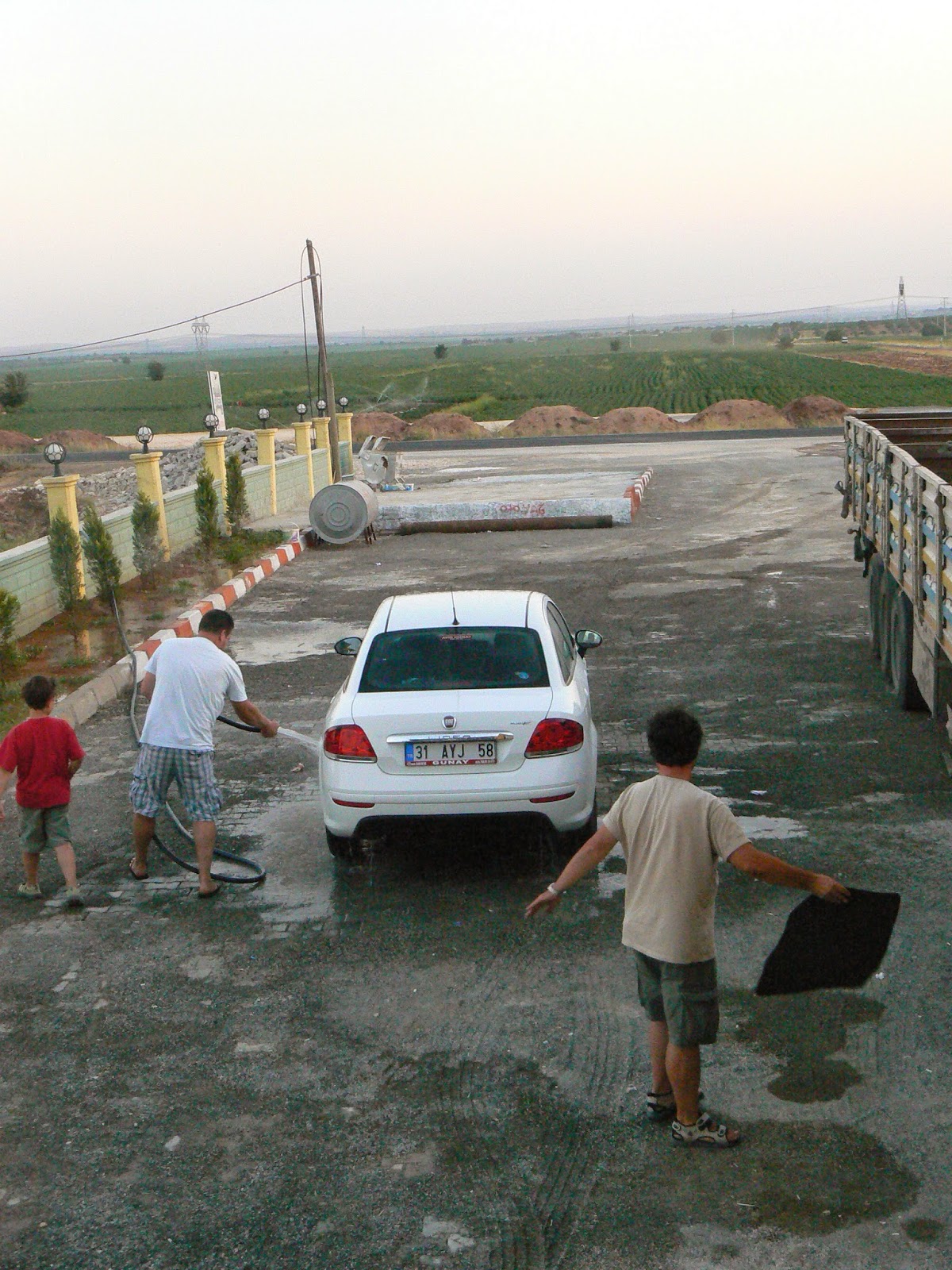
We were hungry after such a long day but it was ramazan and everything was either closed or only served tea. We finally found a lokanta on the side of the road where we had our first and last meal that day, and the guys washed our car. It was fun for my son, he got all wet and enjoyed it very much.


- to be continued -